Tuesday, November 9, 2010

Disney's "Tangled" Character Design Development.

Once "Rapunzel", then "Rapunzel Unbraided", and now "Tangled", Disney's 50th animated Feature film, set for release November 28th, has gone through many changes throughout it's years in development. One thing that hasn't changed much, though, is the artistic influence of two artists in particular. One was the French Rococo painter Jean-Honorer Fragonard, specifically one of his best known works; “The Swing” which inspired the lush fairy tale world that Rapunzel inhabits. The second is animation legend Glen Keane, who was the original driving force behind the film. Glen's masterfully solid, appealing, expressive and  passionate animation and drawings are admired across the globe. He is currently being honored with a gallery exhibit in Paris and is touring with a retrospective of Disney Art in Australia. Below are just a few of Glen's character designs for Rapunzel, Flynn Rider, and Mother Gothel, along with a glimpse of other visual development art for the film. More of these images can be found in the newly released book "The Art of Tangled":

Early concept art:


Glen Keane's drawings:


Final character:


Flynn Rider (Students: keep these expression sheets in mind when doing your final projects!):


Final Character:


Mother Gothel:

  Final Character:


A few other character designs. Who are they? You'll have to see the film to find out!


Thursday, November 4, 2010

Nico Marlet

French born character designer Nicholas Marlet may have only recently gotten a lot of notice for his unique and appealing character designs, but he's been in the business for quite a while. He started as an animator on "Ducktales", "Talespin" and "Balto", doing character design on the latter which lead to a character designer position at Dreamworks. He worked on "The Prince of Egypt", "The Road to El Dorado", "Sinbad", "Madagascar" and "Over the Hedge". But it wasn't until his work on "Kung Fu Panda"and "How to train your Dragon" that he became a household name within the animation community.

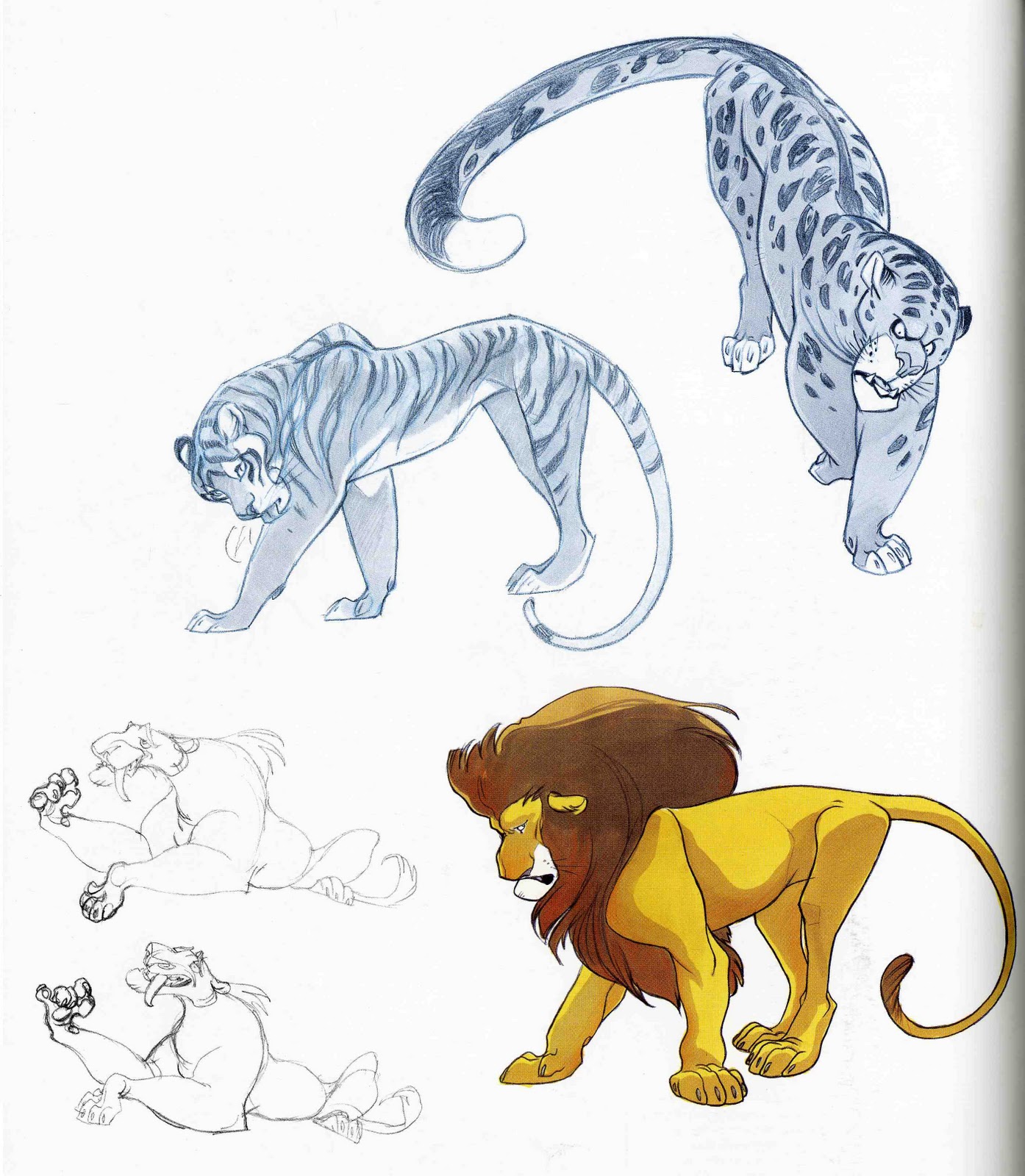
Marlet's early work for traditional animation didn't include his now trademark textures and patterns, but his keen design sense with strong shapes, charming expressions, rock solid anatomy and winning poses clearly shows in this design for an unproduced adaptation of Andrew Lloyd Webber's  "Cats":


"He was so unique in his solutions that I had a hard time finding other people to emulate it,"  Dreamworks production designer Raymond Zibach says of Marlet in this Variety Interview "The way Nico designs, he looks at the actual animal and tries to distill down what's there into something that works for the film," Zibach says. "Some of the rules we followed were actually his, like we don't stick necks straight up out of torsos and then put animal heads on the top or it just looks like a guy in a costume. Instead, we have the neck coming forward, so the head and neck and body are really one unit."

Marlet's early designs explored the panda's basic shape -- round curves, stooped neck, heavy belly. "They're very appealing already," Marlet says of the animal. Then he tested the balance of black and white in the bear's face: "Jeffrey didn't want to have too much black." His breakthrough was the bear's brows, which were big and flexible enough to accommodate the full range of Jack Black's expressions -- even though the actor had yet to be cast when Katzenberg signed off on Marlet's approach.
 (All Ku Fu Panda images from "The Art of Kung Fu Panda" )


Po shape and pose experimental sketches:


For the supporting cast, Marlet had to juggle multiple considerations. In addition to representing the animals' true natures, the designs had to be flexible enough to reflect their respective fighting styles and distinguish the characters not only from one another but also from animated films that had come before. Tigress reflects a particularly striking solution -- and one of Marlet's favorites.

"I love cats," he says. "They are perfect for kung fu. The way they fight is very elegant and at the same time very powerful, almost like a dance. If you look at different styles of tai chi, they do the same movement very slow and hold the pose." Marlet based Tigress' proportions on actual cats, emphasizing the short hind legs and elongated torso, which posed a challenge for the modelers and riggers accustomed to animating human-shaped characters.


Note how the characters are primarily comprised of a few strong shapes; a dominant, which usually dictates the primary action line, just a few subordinates and an accent or two. The small details are all laid in well after the character is fully constructed.
Monkey was adapted to provide more comic relief, evolving from a macaque to a golden monkey to accommodate a wider range of expressions:
Concept art for "The Bee Movie":

Concept Art for "How to Train your Dragon":


How to Train Your Dragon character designs from "The Art of How to Train Your Dragon."

More of Marlet's designs, along with those of several other artists, from the "How to Train Your Dragon" book:

Sunday, October 31, 2010

A study in anthropomorphism: Disney's "Robin Hood"

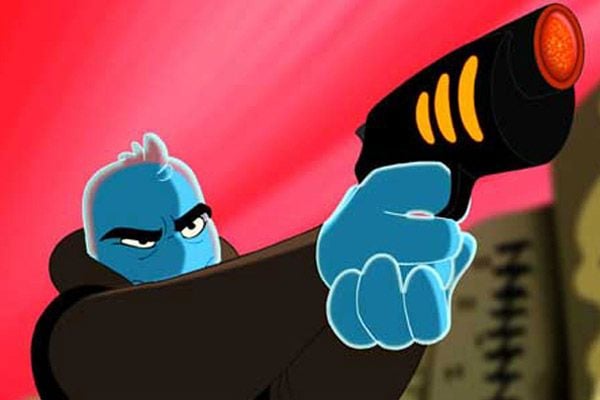
Anthropomorphism is defined as the attribution of human characteristics to animals or non-living things, phenomena, material states and objects or abstract concepts. Examples include animals and plants and forces of nature such as winds, rain or the sun depicted as creatures with human motivations, and/or the abilities to reason and converse. The term derives from the combination of the Greek ἄνθρωπος (ánthrōpos), "human" and μορφή (morphē), "shape" or "form". With such a broad definition one realizes that anthropomorphism covers characters as diverse as Osmosis Jones, Mickey Mouse, HammBagheera, Draco the dragon, and the Pixar luxo lamps. All are anthropomorphic characters, but in animation when one mentions an "anthropomorphic character", they usually mean a very specific type of animal character design. And more often than not the first one that pops into most animator's minds is Disney's Robin Hood.

 
While I can't state definitively why Robin Hood in particular is seen by so many as the quintessential anthropomorphic character,  I can say that he is a classic case of form following function in animated character design.

The studio chose to tell the "Robin Hood" story with animals. A fox, known for being a clever, attractive, and thieving animal, was the natural choice for the title roll. But there's one obvious problem with animating a more natural fox (such as Bagheera, who was a very natural panther); he has to draw a bow.


This becomes quite a trick for a natural fox. His shoulder blades rest on his sides, not across his back, which won't allow him to comfortably rotate his elbow up to eye level while keeping his "forearm" (front leg) straight and horizontal. Comparative anatomy between dog and human skeletons shows us that this is just the beginning of a natural fox's troubles with the role:

His humerus is too short to allow him to draw the bowstring all the way back to the level of his ear, he has no opposable thumbs to allow him to grasp the bow in the first place, and his toes are likely too short to hold an arrow to the string. Plus, standing on what amounts to his tiptoes to do all of this becomes rather awkward.

Famed Warner Brother's animator Chuck Jones had a simple formula for turning the hind legs of animals into easily animated human-like feet for anthropomorphic animals:


Anything covered by the shoe became the foot, while the sock covers the ankle and calf. This is exactly how Robin Hood's hind feet were redesigned. The rest followed in much the same way; The humerus and toes made it halfway to human proportions, and his shoulder blades now rest across his back. In fact, the earlier Robin Hood designs left even more of the natural fox behind in favor of a more cartoony look:


 But form followed function again; Robin had to have a few serious moments in the story, so a slightly more "realistic" and less comedic design was chosen:


Though he's still far from being a natural fox in design. In fact, remove the clothing and have him stand on all fours and the design gets a bit weird:


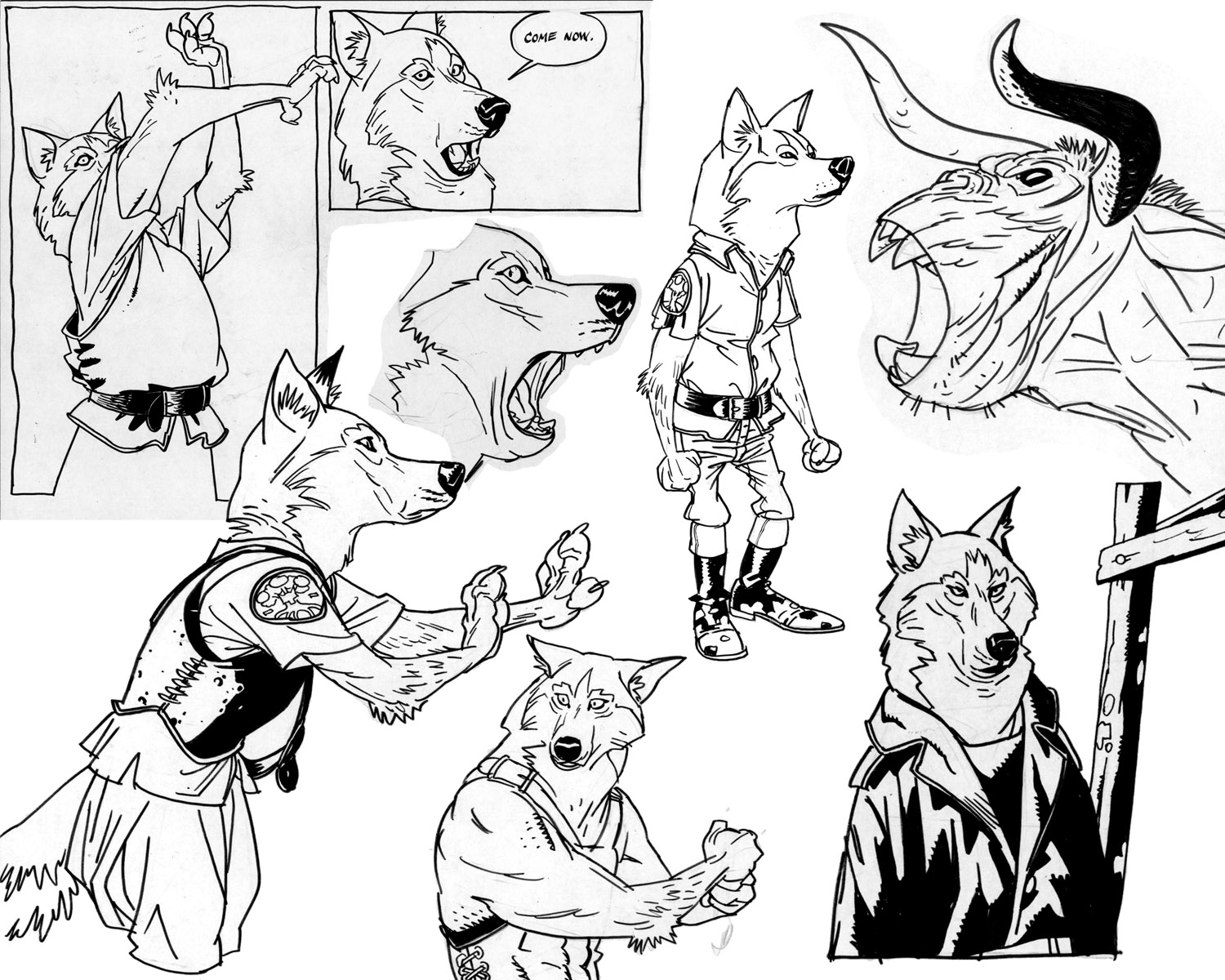
Disney's Robin Hood is clearly meant to be bipedal. Most quadrupeds turned into bipedal anthropomorphic designs either employ the Chuck Jones design method when rendering the hind legs or, as in the case of many rodents and ungulates, they end up keeping their natural legs and often walking on their "tip-toes". When human legs are substituted it can end up looking either like a person wearing a costume or just something that's a bit freaky, as is shown by Rune Bennicke's delightfully odd "weird wolves":


In the end Disney's Robin Hood in a mix of mostly traditional animated fox with enough human anatomy to get through many of the same challenges that Erroll Flynn had to, including drawing that bow. You'll also notice that the muzzle of the character in the final film version gets slightly shorter over time than that in "model sheet #5". This is because animating dialog tends to be a bit easier on a shorter snout (Draco also had a comparatively short muzzle for a dragon):


As always; allow your character's design to follow the functions they must perform in the story. Doing so makes an animator's job much, much easier!


Wednesday, October 27, 2010

Claire Wendling's Cats

"Wendling, Wendling! That's all I hear! And for good reason; look at her draw!"- Peter de Sêve


Born in 1967, this celebrated French artist graduated from the Beaux-Arts d'Angouleme in 1989. Later she won the prize "Alph'Art future" at the Festival of Angoulême. Wendling then joined Editions Delcourt participating in two anthologies, The Children of the Nile and Entrechats . In 1990, Claire Wendling began her first graphic novel series "lights of Amalou", written by Christopher Gibelin.
In 1997 she was hired by Warner Brothers and emigrated to Los Angeles to participate in various projects. Frustrated by the creative constraints of the studio , she returned eight months later to France to continue her career in graphic novels, game design and illustration. Her work is the subject of the rare and sought after art books "Desk", "Iguana Bay", "Drawers", and most recently "Daisies". All I highly recommend; they are available through Amazon.fr, Amazon.ca, Stuart Ng  and Gallery Nucleus

Years ago when I was struggling with an illustration of a lion I asked veteran lead  Disney Animator Ruben Aquino for advice in creating more believable lion anatomy. "Do you have any cats at home?" asked adult Simba's animator. I did. He added "Then that's all you need. It's the same anatomy and behavior; study your own cats, and you'll get the answers that you're looking for." Similarly, Claire Wendling's observations of her own cats have paid off in huge dividends and prove Ruben's point well. Her affection for her subjects is quite evident. When looking at her drawings of felines both large and small, one can imagine that the following illustration is semi-autobiographical:
It all starts with life drawing. As we study animal design in this week's module, take some time to sketch your own pets or those of a friend. If you don't have any handy nearby, try a pet store or animal shelter (go to www.petfinder.com to find those in your area). Those in bigger metropolitan areas may also have access to zoos and wild animal sanctuaries. Wendling's cat life studies can supply some inspiration. Don't stick with static poses alone; catch them in action, include sketches showing typical emotions and behaviors:


Claire Wendling's understanding of domestic feline anatomy and behaviors clearly has aided her in her drawings of bigger cats. It's obvious that she's able to "build a 3D model" in her mind that she can turn and move around into just about any pose imaginable. This is a skill that only comes from many hours of observation:


From the brutal:

To the adorable:


to the fantastic:


Without this through understanding of feline anatomy, designing successful graphic or "cartoony" designs of these animals simply isn't possible. Wendling's cowardly lion and big cat designs for animated films display her understanding of the feline form just as strongly as do the previous pencil studies. As always; study and a through understanding of real world subjects lays the foundations for great character design.


 Exercise: do your own life studies of domestic cats, then view the following video, noting the similarities in both anatomy and behavior between domestic and their wild counterparts. Then try a few video life studies of the larger felines.